

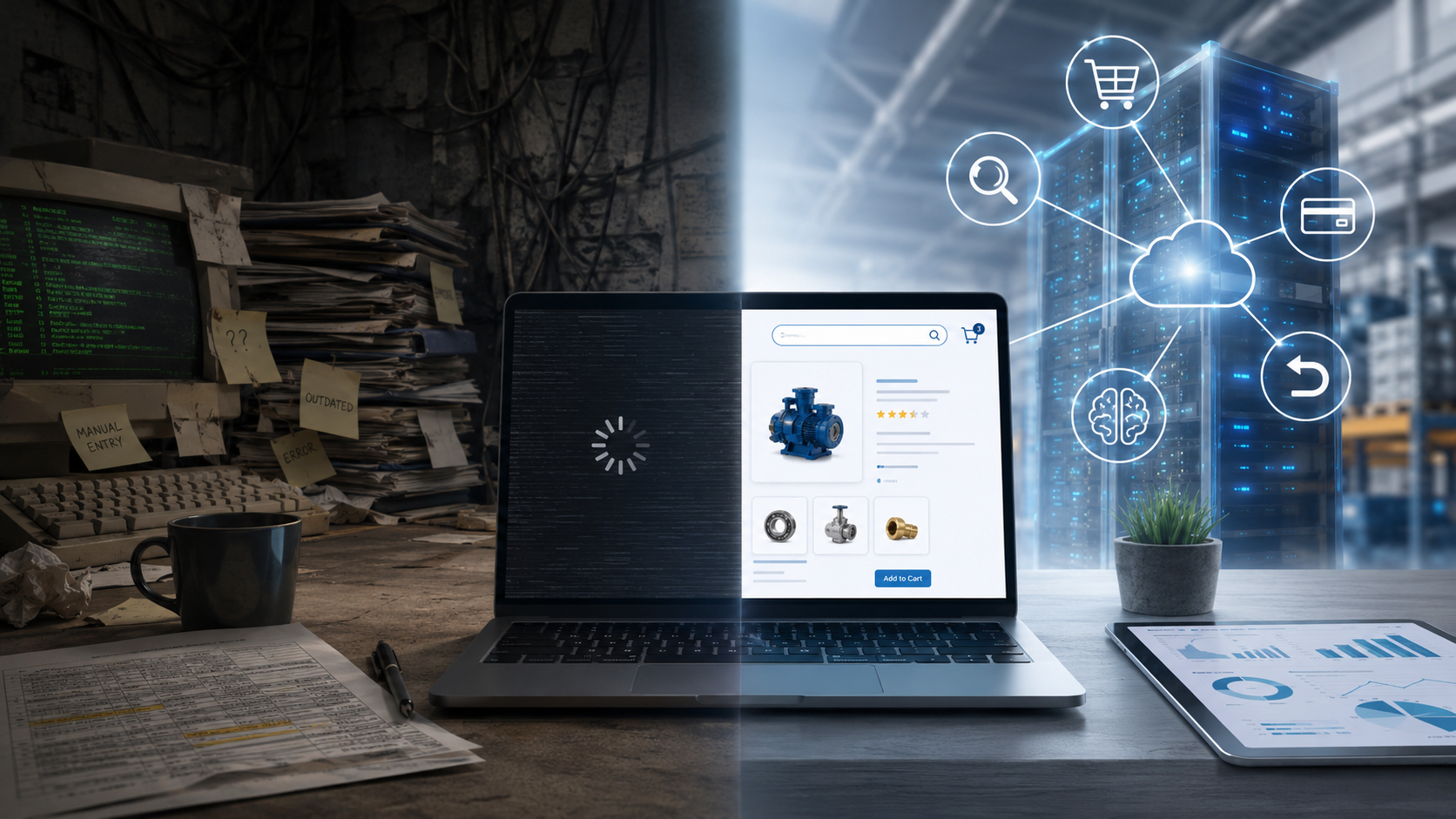
What Your Legacy Platform Is Really Costing You
Staying on a legacy or homegrown eCommerce platform can feel like the right financial decision. The costs are familiar and relatively easy to budget: hosting fees, a maintenance retainer, maybe a contract developer to keep things running. Compared to the price tag of a new platform, the status quo looks reasonable.
But those numbers tell only part of the story.
The true cost of running an aging eCommerce platform includes developer hours consumed by technical debt, manual processes created by poor ERP integration, inaccurate or incomplete product information that drives buyers to competitors, security vulnerabilities that accumulate year over year, and lost digital sales from capabilities the business cannot deploy. When you account for these factors, the total cost of ownership (TCO) of a legacy or homegrown system becomes much higher than it appears on a budget line.
For distributors and manufacturers evaluating whether to modernize, the question is rarely “What will a new platform cost?” The better question is:
“What is our current platform already costing us?”
The Seven Cost Categories You Should Evaluate
1. Developer time, technical debt, and key-person risk
Stripe’s Developer Coefficient survey found developers spend 13.5 of every 40 hours on technical debt, with 52% naming legacy system maintenance as their single biggest productivity drag. For homegrown platforms, the risk goes further: one developer typically holds all the knowledge of how the system works and keeps it running. When that person leaves, that knowledge leaves too, a risk that compounds every year the system stays in place.
2. Human error and manual work
Bookkeep research puts the cost of manual data entry caused by poor system integration at up to 60 hours a month. In practice, it runs higher: one Kore client spent 80 hours a month moving data between its previous eCommerce platform and ERP before switching to Kore Commerce. The accuracy problem is worse: manual data entry runs 1 to 4 percent wrong. A business doing $12M in revenue through manual processes can be exposed to approximately $480,000 in error-driven costs annually.
3. Missing product content and lost buyer trust
When a platform is not tightly integrated with your ERP and product information systems, the gaps appear on every product page: “image coming soon,” missing specifications, stale pricing, wrong inventory levels. A B2B buyer who encounters bad data does not call to complain. They route the next order to a competitor whose site gives them confidence. Legacy systems that pull product data from disconnected sources make this outcome more likely on every transaction.
4. Lost sales from slow pages
Performance is revenue. Google’s web.dev case studies document an 8% sales lift at Vodafone Italy after a 31% improvement in load time. For B2B buyers, a sluggish catalog load is not just a frustrating experience. They take it as a signal about the reliability of your business and move on.
5. Poor user experience, product search, and missed upsell
Finding the right product quickly is the core job of an efficient B2B eCommerce site. Legacy platforms routinely fail at it: text-only results with no images, no ability to surface relevant results from imprecise queries, and no tolerance for the way buyers actually search in the field. A buyer who enters a part description and gets an irrelevant list does not keep trying. They go to a competitor whose site actually works. Modern platforms also surface recommendations and “frequently bought together” pairings that increase average order size on every transaction. HD Supply, a multi-billion dollar B2B distributor, saw a 16% increase in revenue from search after rebuilding its site search so buyers could find products and add them to cart in seconds.
6. Compliance and security exposure
IBM’s 2026 Cost of a Data Breach Report puts the global average cost of a data breach at $4.99 million, a 12% increase over the prior year. In the United States, the average reached a record $11.5 million, nearly double the global figure. Homegrown and legacy eCommerce platforms sit squarely in this risk category: they rarely follow a modern patch schedule, and the developer who originally built the security layer may be long gone. For distributors operating in regulated verticals, these costs do not stay hypothetical for long. A single breach in a medical supply, MRO, or government-adjacent environment can trigger regulatory fines, lost contracts, and customer churn that far outlasts the incident itself.
7. Opportunity cost and the inability to keep pace
Legacy platforms share one defining trait: they cannot adopt what comes next. B2B buyers expect PunchOut integration, self-service payments, and AI-powered search (Forrester expects it to drive 20% of organic traffic). If your platform cannot deliver these, you are not just missing features. You are missing sales. A managed modern platform releases improvements continuously. A homegrown system improves when your developer has capacity, which is rare.
Where Kore Commerce Changes the Math
The distributors that take market share from legacy operators do it by being faster, more accurate, and easier to buy from. The platform underneath that experience is what makes it possible.
The conversation about switching platforms usually starts with cost reduction. But the more significant opportunity is what becomes possible when your team stops spending time keeping aging infrastructure running and starts using a platform built to grow the business.
Kore Commerce is an ERP-integrated, customizable eCommerce platform built specifically for distributors and manufacturers. It integrates natively with Epicor (Eclipse, Kinetic, P21, and Prelude), DDI Inform, UniData/UniVerse, Infor, Oracle JD Edwards, NetSuite, and Microsoft Dynamics through Kore Integrate, a bi-directional data integration and warehousing platform. That connection keeps pricing, inventory, and product information accurate in near-real time, without custom middleware and without keeping a developer on permanent standby.
What that integration unlocks on the buyer side addresses the cost categories above directly:
- AI-powered search that surfaces relevant results even when a buyer queries with a partial part number, a description, or plain language, reducing the dead-end searches that send buyers to competitors
- Product recommendations and “frequently bought together” pairings that increase average order size on every transaction
- Self-service online payments that reduce accounts receivable friction
- PunchOut integration for customers who purchase through corporate eProcurement platforms, removing a common barrier for mid-market and enterprise accounts
- Job site management for project-based and multi-location orders
- Returns and repair management (RMA) that handles credits and exchanges without routing calls through your customer service team
On the security and compliance side, Cloudflare integration and active patch management address the exposure that legacy and homegrown platforms accumulate over time. For distributors where a breach carries consequences well beyond the immediate cost, this is not an optional feature.
For organizations that want to address the full TCO picture, Kore Commerce is part of a broader platform. Kore Integrate handles ERP data synchronization and warehousing. Kore Managed Data Services (KMDS) delivers clean, enriched product content that closes the information gaps that erode buyer trust and suppress conversion. Together, they address every cost category this post covers.
The results are documented. Read our case study on how a $250M industrial distributor saw a 23% increase in average order size and an 8% lift in order volume after moving to Kore Commerce.
Take the Next Step
Stop paying to stand still. Request to meet with an expert and see what your current platform is really costing you.